 buffro
How Many Sets Per Muscle Group Per Week?
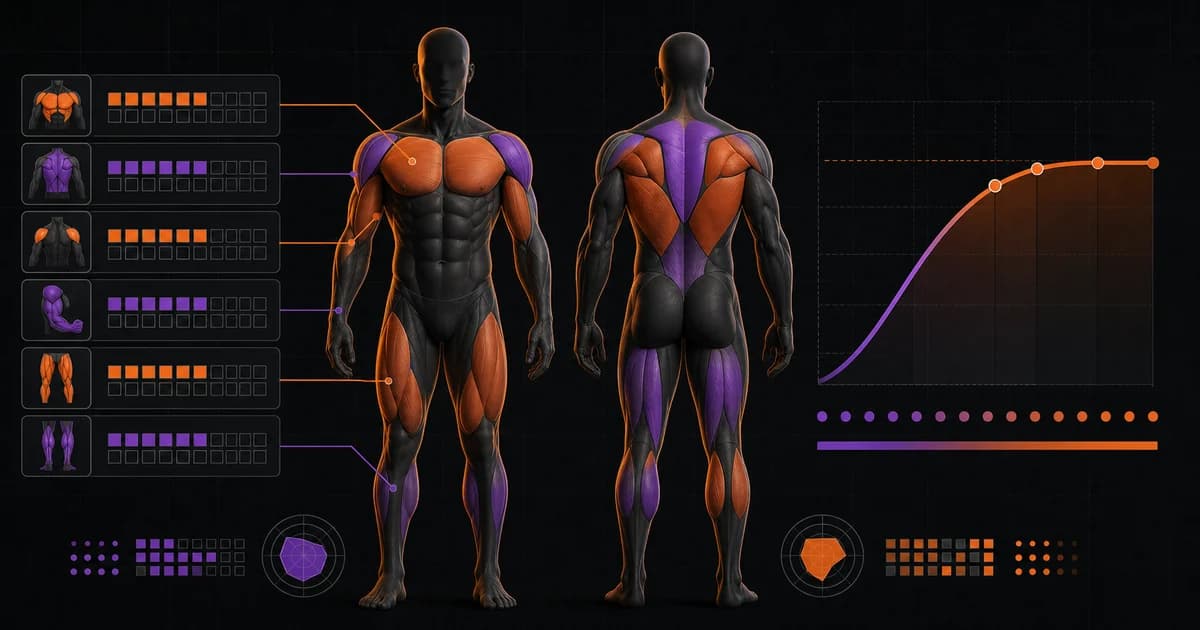
Short answer: start near 10 effective hard sets per muscle per week. Many lifters can progress on roughly 6-15; the familiar 10-20 range is a planning zone for people who need more work, not a universal minimum and maximum.
Research generally finds that more weekly resistance-training volume can produce more muscle growth, but the return from each added set gets smaller. The newest broad meta-regression also found that the answer changes depending on whether indirect work is ignored, counted fully, or counted as a half set. That analysis favored fractional counting and found diminishing returns. This is why one fixed number cannot be optimal for every muscle and every lifter.
What counts as a weekly set?
Count a working set when it uses the target muscle through a useful range of motion and becomes challenging enough that only a few clean repetitions remain. Warm-ups, technique practice far from fatigue, and casual movement do not belong in the weekly total.
- Direct set: count 1. A curl is direct biceps work; a leg extension is direct quadriceps work.
- Meaningful indirect set: count about 0.5. A hard row trains the back directly and the biceps indirectly. A bench press trains the chest directly and the triceps indirectly.
- Tiny contribution: count 0. Do not turn every exercise into volume for every muscle that helps stabilize it.
Weekly effective-set calculator
Count direct sets at full value and secondary-muscle work at half value. The half-set convention is a planning model, not a biological law.
Practical starting sets by muscle
These are conservative starting ranges for healthy adults doing challenging sets, not research-proven universal optima. Begin near the lower end when the exercise is new, when recovery is limited, or when a muscle already gets lots of compound work.
| Muscle | Starting effective sets/week | How to count them |
|---|---|---|
| Chest | 8-14 | Count presses fully for chest; add fly variations as direct work. |
| Back | 10-16 | Combine vertical pulls and rows instead of repeating one pattern. |
| Side and rear delts | 8-14 | Count direct raises and rear-delt work; pressing already covers front delts. |
| Quads | 8-14 | Squats, leg presses, split squats, and extensions all contribute. |
| Hamstrings | 6-12 | Use both hip-hinge and knee-flexion work when possible. |
| Glutes | 6-12 | Squats and hinges contribute; count their glute stimulus honestly. |
| Biceps | 6-12 effective | Direct curls count fully; rows and pulldowns can count fractionally. |
| Triceps | 6-12 effective | Direct extensions count fully; presses can count fractionally. |
| Calves | 6-12 | Usually direct work, split between straight- and bent-knee patterns. |
| Abs | 4-10 | Count deliberate loaded or challenging trunk work, not every compound lift. |
A direct-versus-indirect example
Suppose a week contains six hard bench-press sets, four chest-fly sets, and six triceps-extension sets. Chest receives about 10 direct sets. Triceps receive six direct sets plus roughly three effective sets from pressing, for about nine effective sets total.
The same model works for pulling: eight hard row and pulldown sets can count as eight back sets and roughly four biceps sets. Add six curl sets and the biceps total becomes about 10. The half-set is an estimate; if your grip, technique, or exercise choice barely challenges the arms, count less.
Beginner, intermediate, and advanced volume
Beginner: usually 4-8 direct sets
New lifters can improve with modest volume because nearly every well-performed set is a new stimulus. Focus on repeatable technique and adding repetitions or load before adding more exercises.
Intermediate: often 8-14 effective sets
This is where counting indirect work matters. Hold volume stable long enough to see whether strength and repetitions are moving before changing it.
Advanced: use the volume you can recover from
Experienced lifters may need more work for selected muscles, but they also create more fatigue per hard set. Add volume to a priority muscle instead of pushing every body part toward 20 sets at once.
How often should you train each muscle?
For hypertrophy, weekly volume appears more influential than frequency by itself. Training a muscle twice per week is still a useful default because it distributes fatigue and keeps individual sessions productive. The 2026 meta-regression found frequency more consistently related to strength gains than hypertrophy, with diminishing returns for both.
If you have 12 back sets, six on Monday and six on Thursday will usually be easier to perform well than all 12 in one session. A push/pull/legs routine, upper/lower split, or full-body plan can all work; choose the schedule you can repeat.
When to add or remove sets
Keep a program stable for roughly four to six weeks unless it is clearly causing a problem. Track the exercises, loads, repetitions, technique, and recovery, not just the set total. Then adjust one priority muscle at a time.
- Add about two weekly sets when progress has genuinely stalled, technique is stable, and the muscle feels recovered before its next session.
- Remove two to four sets when performance declines across sessions, soreness repeatedly disrupts the next workout, or joint irritation grows.
- During a calorie deficit or a stressful period, maintaining strength with less volume is often more useful than forcing a growth-volume target you cannot recover from.
Set count only matters when it supports progressive overload. More sets without stable performance are more workload, not automatically more growth. Rest long enough to preserve useful repetitions; see the guide to rest between sets.
Common questions
Is 10 sets per muscle per week enough?
Often, yes. Ten effective sets is a sensible starting point, not a threshold below which growth cannot happen. A beginner may need less; an experienced lifter may need more for a priority muscle.
Is 20 sets per muscle too much?
Not automatically, but it is high enough to justify scrutiny. Twenty productive sets split across the week can work for some lifters. Twenty sets added on top of overlapping compound work may be more fatigue than stimulus.
Do warm-up sets count?
Usually no. Warm-ups prepare the movement without approaching the effort of a working set. A heavy final warm-up can create fatigue, but it still should not be used to inflate the planned growth volume.
Must every working set reach failure?
No. A set can be productive when it ends with a small number of clean repetitions in reserve. Taking every compound set to failure can make recovery harder without making every set more useful.
An older dose-response meta-analysis also found greater average hypertrophy with greater weekly volume, while its category analysis compared fewer than 5, 5-9, and 10 or more sets rather than establishing 10 as a magic cutoff. Read the 2017 meta-analysis. A 2023 network meta-analysis found that many resistance-training prescriptions improved strength and hypertrophy, reinforcing that several workable setups exist. Read the 2023 analysis.
Sources
- Pelland et al. (2026), weekly volume and frequency meta-regressions
- Schoenfeld, Ogborn and Krieger (2017), weekly volume dose-response meta-analysis
- Currier et al. (2023), resistance-training prescription network meta-analysis
Buffro summarizes published research for general education. It does not replace individualized medical advice or coaching. Read our editorial policy.